Pool Water Chemistry 101: The Seven Numbers That Matter
Free chlorine, pH, alkalinity, calcium, stabilizer, salt and combined chlorine — what each number does, the range to aim for, and how to move it.
Key takeaways
- Free chlorine and pH are the two numbers to test several times a week; the rest monthly.
- Keep free chlorine at least 7.5% of your stabilizer (CYA) level — that ratio matters more than any single number.
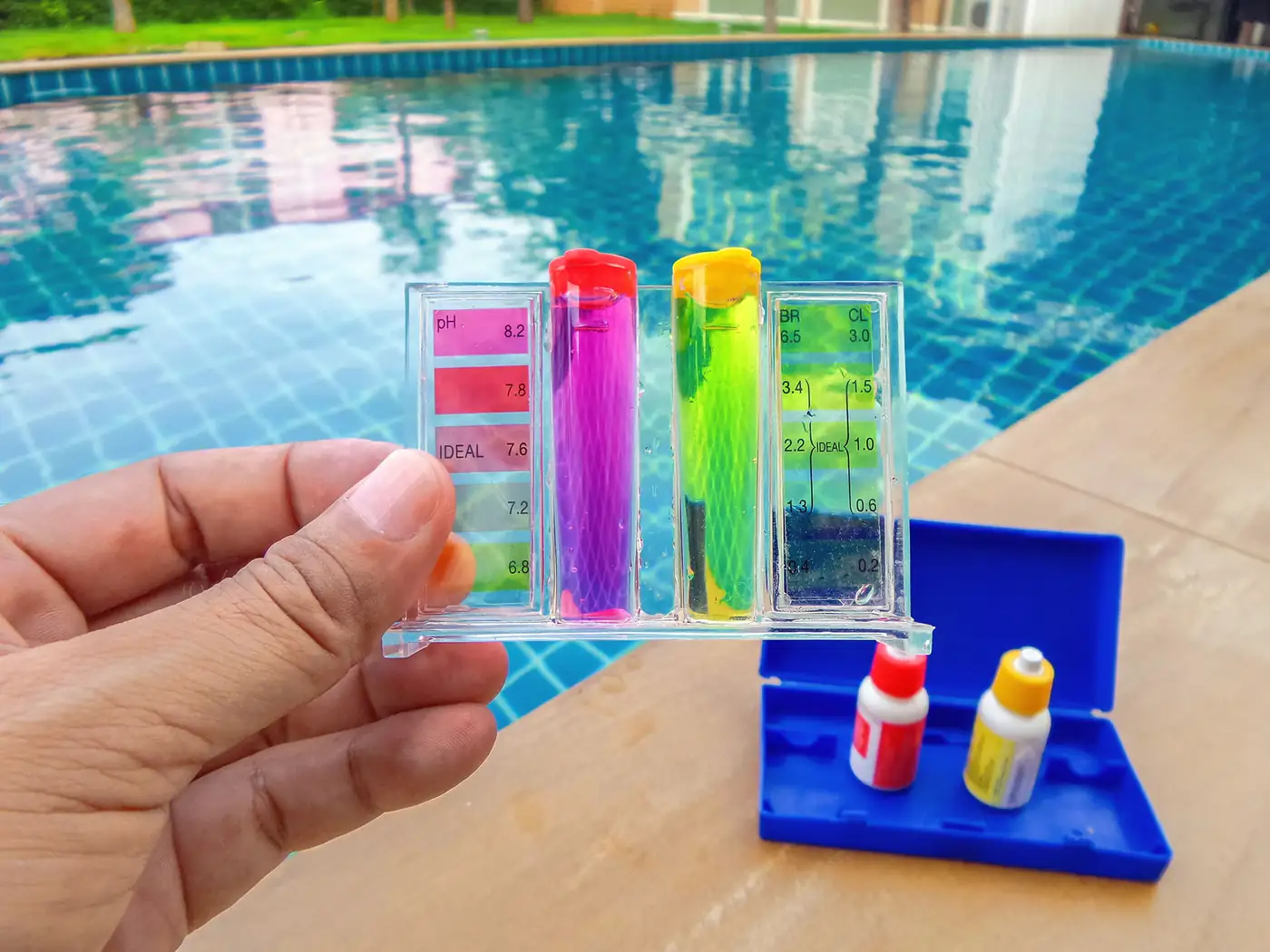
- A good drop-based test kit beats strips for chlorine, CYA and calcium readings.
- Change one thing at a time, circulate, then retest before you adjust again.
Clear, comfortable pool water comes down to a handful of numbers. Get them in range and the water stays sparkling with surprisingly little work. Let them drift and you get the classics: green water, cloudy water, scale, stinging eyes and chlorine you keep adding but can never seem to hold.
Here are the seven numbers pool techs actually watch, what each one does, and how to move it when it is off.
1. Free chlorine (FC): 1–4 ppm, tied to your CYA
Free chlorine is the chlorine that is available to kill bacteria and algae. It is the single most important number in your pool. Most outdoor residential pools do well holding 3–5 ppm day to day, but the right number really depends on how much stabilizer (CYA) is in the water, because CYA binds to chlorine and slows it down.
Keep free chlorine at no less than 7.5% of your CYA. With CYA at 40 ppm, that is a floor of 3 ppm. Use our chlorine & stabilizer chart to see your minimum, target and shock levels.
To raise it: liquid chlorine (sodium hypochlorite) is the cleanest option because it adds nothing else to the water. Cal-hypo adds calcium; dichlor and trichlor add stabilizer. To lower it: stop adding chlorine and let the sun do the work, or use a chlorine neutralizer if you badly overshot.
2. pH: 7.4–7.6 ideal (7.2–7.8 acceptable)
pH measures how acidic or basic the water is. Low pH etches plaster, corrodes metal and stings eyes. High pH makes chlorine much less effective and pushes calcium out of solution as cloudy water and scale.
To lower pH: muriatic acid or dry acid (sodium bisulfate), added slowly in front of a return with the pump running. To raise pH: soda ash, or simply aerate the water (fountains, spillovers, jets pointed up) — aeration raises pH without raising alkalinity.
3. Total alkalinity (TA): 80–120 ppm
Alkalinity is pH’s shock absorber. Too low and pH swings wildly; too high and pH constantly drifts upward. Many salt pools and plaster pools hold pH more steadily with alkalinity in the 60–80 ppm range.
To raise TA: baking soda (sodium bicarbonate) — about 1.4 lb raises 10,000 gallons by 10 ppm. To lower TA: add acid to drop pH to around 7.0–7.2, then aerate to bring pH back up. Repeat until alkalinity reaches target.
4. Calcium hardness (CH): 200–400 ppm for plaster
Water wants a certain amount of dissolved calcium. If there is too little, it pulls calcium out of plaster, grout and pebble finishes (etching). Too much, and it deposits scale on tile, in heaters and in salt cells. Vinyl and fiberglass pools are less sensitive; 150–250 ppm is fine for most.
To raise CH: calcium chloride. To lower CH: partially drain and refill with softer water — there is no chemical that removes calcium.
5. Cyanuric acid (CYA, stabilizer): 30–50 ppm
CYA shields chlorine from sunlight. Without it, an outdoor pool can lose most of its chlorine in a single sunny afternoon. With too much, chlorine becomes sluggish and algae gets a foothold. Salt pools typically run 60–80 ppm. Indoor pools need little or none.
CYA only leaves the pool through dilution (splash-out, backwashing, rain overflow, draining). That is why daily use of trichlor tablets or dichlor shock eventually pushes CYA too high. If yours is above 80–90 ppm, a partial drain and refill is usually the fix.
6. Salt: 2,700–3,400 ppm (salt pools only)
Salt chlorine generators need salt in a specific window to make chlorine. Most cells target around 3,200 ppm — always follow your cell manufacturer’s spec. Salt does not get used up; it leaves through splash-out and backwashing, so top-ups are occasional.
7. Combined chlorine (CC): under 0.2 ppm
Combined chlorine is chlorine that has already reacted with sweat, urine and other nitrogen compounds (chloramines). It is what causes the classic “chlorine smell” and red eyes. If CC is above about 0.5 ppm, raise free chlorine to shock level and hold it until CC drops.
How often to test
| Test | How often | Why |
|---|---|---|
| Free chlorine | 2–3× per week (daily in summer heat) | Chlorine is consumed constantly |
| pH | 2–3× per week | Drifts with aeration, acid and chlorine type |
| Total alkalinity | Weekly to monthly | Changes slowly |
| Calcium hardness | Monthly | Rises with evaporation and cal-hypo |
| CYA | Monthly | Builds with stabilized chlorine |
| Salt | Monthly | Leaves with splash-out and backwash |
Strips or a drop kit?
Test strips are fine for a quick check, but they struggle with high chlorine levels and give rough CYA readings. A quality drop-based (titration) kit that measures free chlorine with the FAS-DPD method gives precise numbers — and precise numbers mean fewer chemicals and fewer surprises.
The one habit that prevents most problems
Change one thing at a time. Add the chemical, let the pump circulate for at least 30 minutes to a few hours (longer for calcium and CYA), then retest before you adjust anything else. When you are not sure how much to add, run the numbers in our chemical dosing calculator.
Still have a question about this?
Ask a Pool Tech